Table of contents
- Overview of Company Formation in Cyprus
- Why incorporate in Cyprus
- A solid reputation and double taxation treaties
- The step-by-step process of Cyprus Company Registration
- Choosing the right company structure in Cyprus
- Other business structures
- What are the costs: fees and maintenance
- Key annual costs to budget for
- Ongoing compliance and management
- Keeping records up to date
- Common pitfalls to avoid during registration
- How our law firm can assist
- Final Considerations
- FAQ on Cyprus company registration
Overview of Company Formation in Cyprus
The registration of a company in Cyprus is governed by the Companies Law, Cap. 113, and follows a clearly defined legal and administrative process. While the procedure is structured and predictable, it requires careful planning regarding corporate structure, tax position, regulatory obligations, and operational requirements.
In practice, many businesses and investors encounter uncertainty during the initial stages of Cyprus company registration. This is not due to complexity in the legislation itself, but rather due to the number of legal, compliance, and procedural elements that must be addressed correctly from the outset. If these elements are not properly managed, they may cause delays or complications, particularly in banking onboarding, tax registration, and ongoing compliance.
Cyprus remains a well-established jurisdiction for international business within the European Union. Its legal framework, EU membership, and regulatory environment provide a credible and structured basis for corporate activity. However, the advantages of the jurisdiction can only be realised where the company is properly structured, effectively managed, and compliant with all applicable obligations.
This guide provides a comprehensive overview of Cyprus company registration. It explains the legal framework, outlines the step-by-step incorporation process, examines cost considerations, and sets out the ongoing obligations that apply to Cyprus companies.
Why incorporate in Cyprus
Cyprus has developed into a recognised jurisdiction for corporate structuring and international business operations. Its appeal is based on legal certainty, regulatory credibility, and access to European markets.
Corporate tax framework
Cyprus applies a corporate income tax rate of 15% as of 2026. This rate remains competitive within the European Union and aligns with international tax standards. It supports a transparent and compliant environment while allowing businesses to manage their tax position efficiently.
European Union membership
Cyprus is a member of the European Union. A Cyprus company benefits from access to the EU single market, including the free movement of goods, services, and capital. This supports cross-border operations and simplifies engagement with clients and counterparties across member states.
Legal system
The legal system of Cyprus is based on English common law. This provides a predictable framework for corporate governance, contractual arrangements, and dispute resolution, which is familiar to international investors.
A solid reputation and double taxation treaties
Cyprus has established a strong reputation as a jurisdiction for international business and corporate structuring. Its regulatory framework is recognised by financial institutions, investors, and multinational groups.
One of the key advantages of Cyprus is its network of double taxation treaties. Cyprus has entered into agreements with more than 60 countries, designed to prevent the same income from being taxed in multiple jurisdictions.
These treaties are particularly relevant in structuring international transactions. They enable more efficient treatment of cross-border payments, such as dividends, interest, and royalties, and can significantly reduce withholding tax exposure, subject to applicable conditions.
Cyprus also offers a robust legal framework for intellectual property protection under European Union law. This makes it suitable for businesses that hold or manage intellectual property assets, including technology companies and creative industries.
Ready to Register Your Company in Cyprus?
Start your Cyprus company with the correct legal structure and full compliance from the start. Our team manages the process from registration to ongoing obligations.
The step-by-step process of Cyprus Company Registration
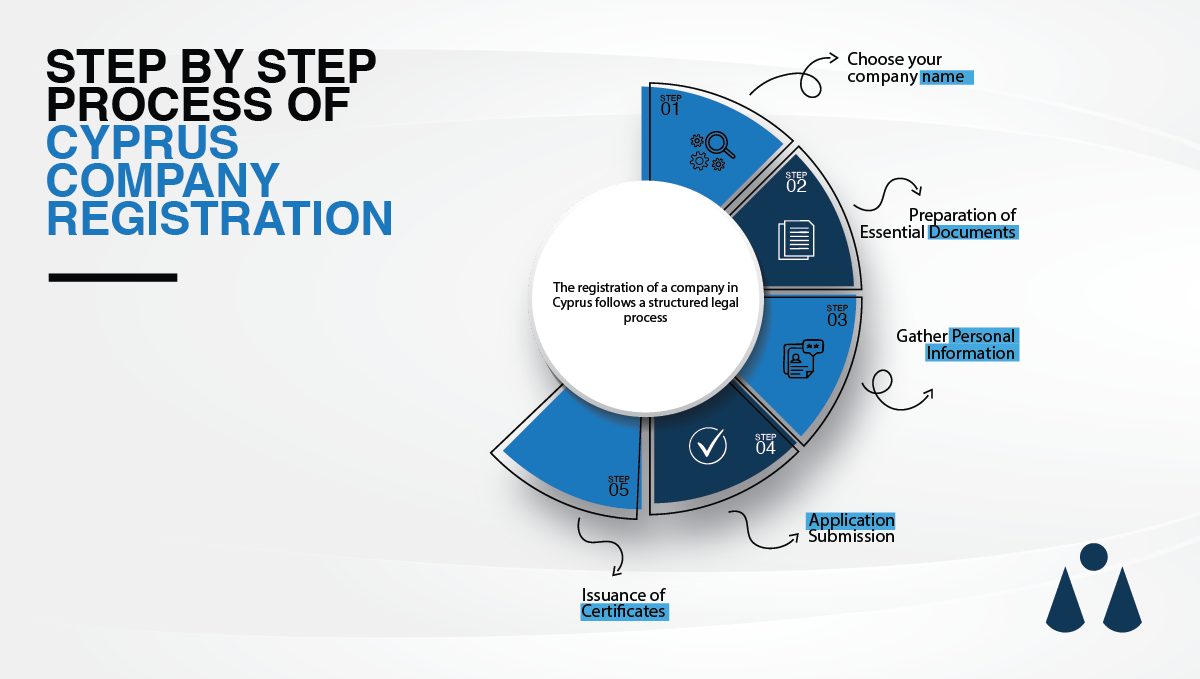
The registration of a company in Cyprus follows a structured legal process. Each stage must be completed accurately to ensure that the company is incorporated without delay and can operate effectively.
1. Choose your company name
The first step is to obtain approval of the proposed company name from the Registrar of Companies.
The name must be sufficiently distinct from existing registered entities and must not create confusion in the market. Names that are misleading or that suggest an association with government authorities or regulated activities may be rejected or may require additional approval.
In practice, it is advisable to submit multiple name options to avoid delays if the preferred name is not approved.
2. Preparation of Essential Documents
Once the company name is approved, the incorporation documents must be prepared.
The Memorandum and Articles of Association form the company’s constitutional documents. The Memorandum sets out the company’s name, objects, and share capital. At the same time, the Articles regulate the company’s internal governance, including the roles and powers of directors and the rights of shareholders.
Although standard templates are often used, any specific provisions must be carefully drafted to reflect the intended corporate structure, ownership arrangements, and governance model.
In addition, statutory forms must be completed. These include details of the directors, shareholders, registered office, and beneficial owners. The identification and disclosure of beneficial ownership are mandatory under Cyprus law and form part of the jurisdiction’s anti-money laundering framework.
3. Gather Personal Information
The incorporation process requires the submission of due diligence documentation for all relevant parties.
This includes certified copies of passports and proof of residential address for directors, shareholders, and beneficial owners.
In certain cases, particularly where non-European Union shareholders are involved, reference letters from banks or professionals may also be required. These requirements arise from anti-money-laundering and know-your-client regulations and are strictly enforced in practice.
Proper preparation and certification of these documents is essential to ensure that the incorporation process proceeds efficiently and without unnecessary delays.
4. Application submission
Once all documentation has been prepared, the incorporation application is submitted to the Registrar of Companies.
This step is typically carried out by legal professionals or corporate service providers, who ensure that the application complies with all statutory and procedural requirements.
The Registrar reviews the application and, if satisfied, proceeds with incorporation. Any errors, inconsistencies, or missing information may result in delays or requests for additional clarification.
5. Issuance of Certificates
Upon approval, the Registrar issues the certificate of incorporation, which confirms the company’s legal existence. Additional certificates are also issued, including those relating to directors, shareholders, and the registered office.
Following incorporation, the company must complete several additional steps. These include registering with the Tax Department, assessing VAT registration requirements based on the nature and scale of the business, and submitting beneficial ownership information to the central register.
The company must also open a corporate bank account. This stage involves detailed due diligence procedures, including verification of ownership, business activity, and source of funds. It may take several weeks, depending on the company’s structure and risk profile. Learn more about our Banking & Payment solutions and how our expert can assit you.
Choosing the right company structure in Cyprus
The selection of the appropriate company structure is a key legal and commercial decision. The structure determines liability, governance, regulatory obligations, and the way the business operates in practice. Get in touch with our corporate lawyers to choose the right structure for your business.
In Cyprus, the most commonly used structure for both local and international business is the private company limited by shares (LTD).
A private limited company (LTD) is a separate legal entity distinct from its shareholders. The liability of shareholders is limited to the amount of their shareholding. This means that personal assets are protected in the event of the company’s financial obligations or liabilities.
This structure offers flexibility in ownership and management. A Cyprus LTD may be incorporated with a single shareholder and a single director. It is widely used for trading activities, holding structures, investment vehicles, and international operations due to its simplicity and legal recognition.
Shares in a private company are not freely transferable to the public. This restriction allows control over ownership and is suitable for privately held businesses.
Other business structures
While the private limited company is the most commonly used structure, other legal forms are available depending on the nature and scale of the business.
- Public limited company (PLC): A PLC is typically used by larger entities that intend to raise capital from the public. This structure requires a minimum number of shareholders and is subject to stricter regulatory and disclosure requirements. Shares in a public company may be offered to the public and are generally freely transferable.
- Branch: A branch of a foreign company allows an existing entity incorporated in another jurisdiction to establish a presence in Cyprus. The branch is not a separate legal entity. Instead, the foreign parent company remains fully liable for the activities of the branch. This structure is often used where an established business wishes to expand operations into Cyprus without creating a new legal entity.
- Partnership: A partnership may also be formed, depending on the business model. In a general partnership, partners are jointly and severally liable for the business’s obligations. Limited partnerships are also available, where liability is limited for certain partners under specific conditions. Partnerships are less commonly used for international structuring due to liability considerations.
In certain cases, more specialised structures may be considered. These include cross-border arrangements under European Union frameworks or group structures involving multiple jurisdictions. The selection of structure should always reflect the intended business activity, ownership model, and regulatory exposure.
What are the costs: fees and maintenance
The cost of company formation in Cyprus depends on the complexity of the structure and the level of professional support required.
In standard cases, incorporation costs typically range between €1,200 and €4,000. These costs include the preparation of legal documentation, submission to the Registrar of Companies, and initial corporate setup.
Statutory fees apply in addition to professional costs. These include government filing fees and the annual levy of €350 payable to the Registrar.
Key annual costs to budget for
Once incorporated, a Cyprus company must incur annual costs to remain in good standing.
These include registered office services, company secretarial support, accounting and audit services, and the preparation and filing of annual returns.
Accounting and audit obligations are mandatory. Companies must maintain proper accounting records, prepare financial statements, and have them audited annually in accordance with applicable requirements. Explore our accounting services for full support with financial reporting and compliance.
Ongoing compliance and management
Cyprus companies are subject to ongoing compliance obligations.
The company must file an annual return with the Registrar of Companies that reflects its current corporate structure. Financial statements typically accompany this filing and must be completed within the applicable statutory deadlines.
In addition, the company must comply with tax reporting obligations, maintain proper accounting records, and ensure that all regulatory filings are completed accurately and on time.
Ongoing compliance requires accurate accounting records and timely financial reporting. For further information on how these obligations can be managed in practice, check our accounting services.
Keeping records up to date
All changes to the company’s structure must be formally recorded and submitted to the Registrar.
This includes changes to directors, shareholders, beneficial ownership, registered office, and share capital. Maintaining accurate, up-to-date records is essential to ensure compliance and avoid administrative penalties.
Common pitfalls to avoid during registration
Certain issues commonly arise during the company formation process.
Incomplete or improperly certified documentation is a frequent cause of delays. Selecting an inappropriate company name may also result in rejection by the Registrar.
Another common issue is underestimating the requirements for ongoing compliance and banking procedures. Financial institutions apply strict due diligence requirements, and insufficient preparation may delay or prevent the opening of a corporate bank account.
Engaging experienced legal and corporate advisors helps to mitigate these risks and ensures that the process is handled correctly from the outset.
How our law firm can assist
Establishing and managing a Cyprus company requires coordination across legal, tax, and compliance sectors. Each stage, from structuring and incorporation to ongoing reporting and regulatory submissions, must be handled with precision.
Michael Chambers & Co. LLC offers comprehensive support in company formation, corporate structuring, accounting, and ongoing compliance. Our team guides clients throughout the entire lifecycle of a Cyprus company, ensuring that all legal and regulatory obligations are fulfilled promptly and efficiently.
More information about our Corporate services and Accounting services can be found within our practice areas.
Final Considerations
The registration of a company in Cyprus is a structured legal process that requires careful planning and execution.
When properly managed, Cyprus provides a reliable and efficient jurisdiction for international business. Its legal framework, tax system, and access to European markets offer a strong foundation for corporate activity.
Professional guidance ensures that the company is established correctly, remains compliant with applicable obligations, and is positioned for effective operation.
FAQ on Cyprus company registration
Cyprus offers access to the European Union, a structured legal system, and a competitive and compliant tax framework.
The most common structure is the private company limited by shares, although other structures, such as branches and partnerships, are also available.
A company secretary is required by law. A local director is not mandatory, but it is often relevant for demonstrating management and control for tax residency purposes.
The incorporation process typically takes between five and ten working days, subject to the completeness and accuracy of documentation.
Costs vary depending on the structure and services required, but typically range between €3,700 and €6,000 in the first year.
Yes, Cyprus allows full foreign ownership without restrictions, subject to standard due diligence requirements.
A Cyprus company must have a registered office address within the jurisdiction. This address is used for official correspondence and regulatory purposes. A physical operational presence may be required depending on the business activity and substance considerations.
A corporate bank account is required for the company’s operations. While accounts may be opened in Cyprus or abroad, banks apply strict due diligence procedures, and the process may take several weeks, depending on the company’s structure and activities.
VAT registration is required when the company carries out taxable activities, meets the applicable thresholds, or engages in certain cross-border transactions. The requirement depends on the nature and scale of the business.
Cyprus companies must maintain accounting records, prepare audited financial statements, file annual returns, and comply with tax reporting obligations. Companies must also keep their corporate information up to date with the Registrar of Companies.